One more row. Then just one more.
And then you glance at the pattern and it says Hook: H/8, but the hook in your hand is labeled 5.0 mm, and your yarn label suggests something like 5.5 mm. Cozy, yes. Confusing, also yes.
Let’s turn all those letters, numbers, and millimeters into something you can actually use, especially when you are swapping hook brands or trying to match a yarn label to a pattern.
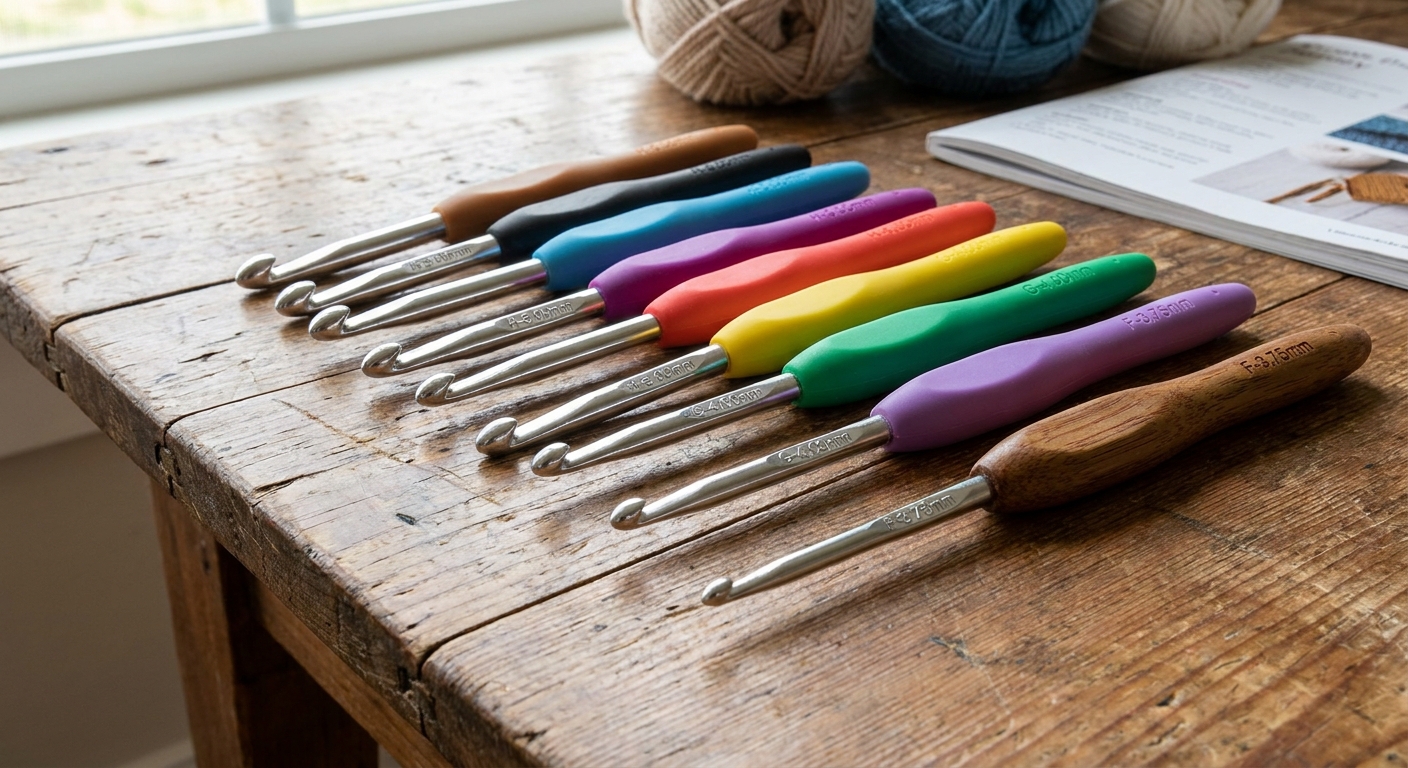
Crochet hook size chart (mm, US)
Millimeters are the most precise way to talk about hook size. US letters and numbers are common in American patterns and packaging.
Important: there isn’t one perfect universal conversion. Different brands and older vs newer charts can map a US letter to slightly different millimeters, especially in the in-between and jumbo sizes. Use this chart as a practical starting point, then confirm your hook’s mm (it is usually printed on the hook) and crochet a quick swatch if gauge matters.
Quick rule: if your hook is marked in millimeters, trust the millimeters.
Regular yarn hooks (not steel thread hooks)
| Metric (mm) | Common US size (varies) |
|---|---|
| 2.00 | No widely used US letter |
| 2.25 | B/1 |
| 2.75 | C/2 |
| 3.25 | D/3 |
| 3.50 | E/4 |
| 3.75 | F/5 |
| 4.00 | G/6 |
| 4.50 | 7 (also seen as G+/7, varies by brand) |
| 5.00 | H/8 |
| 5.50 | I/9 |
| 6.00 | J/10 |
| 6.50 | K/10.5 |
| 8.00 | L/11 (varies by brand) |
| 9.00 | M/13 |
| 10.00 | N/15 |
| 12.00 | P/16 |
| 15.00 | Q (jumbo letters vary by brand) |
| 16.00 | R or S (jumbo letters vary by brand) |
| 19.00 | No widely used US letter |
| 20.00 | No widely used US letter |
| 25.00 | No widely used US letter |
UK sizing note
Older UK patterns often use UK numbers, but they are not reliably standardized across decades and publishers. That is why you will not see a neat UK conversion column here. When you run into UK numbering, use the mm listed on the hook or pattern (if available) and let gauge be the final decision-maker.
Steel hook chart (thread hooks)
Steel crochet hooks are used for thread crochet, lace, doilies, and very fine yarn or thread details. They use a separate numbering system, and the numbering can flip depending on the system and the manufacturer.
- In the US steel system, a larger number usually means a smaller hook (for example, size 10 is smaller than size 6).
- In metric, the number is simply the shaft diameter in millimeters.
Because steel hook numbering varies by manufacturer and era, the safest habit is this: treat the millimeter as the truth and the size number as a helpful nickname.
Before you use the table: these are common approximations, not a guarantee. Always check the mm stamped on your specific hook when you can.
| Metric (mm) | Common US steel size (approx., varies) | Typical use |
|---|---|---|
| 1.90 | 5 (often) | Thread crochet, lace |
| 1.80 | 6 (often) | Thread crochet |
| 1.65 | 7 (often) | Thread crochet |
| 1.50 | 8 (often) | Finer thread |
| 1.40 | 9 (often) | Finer thread |
| 1.30 | 10 (often) | Doilies, lace |
| 1.10 | 12 (often) | Very fine thread |
| 1.00 | 13 (often) | Very fine thread |
| 0.90 | 14 (often) | Very fine thread |
| 0.85 | 15 (often) | Very fine thread |
| 0.75 | 16 (often) | Extremely fine thread |
| 0.70 | 17 (often) | Extremely fine thread |
| 0.60 | 18 (often) | Extremely fine thread |
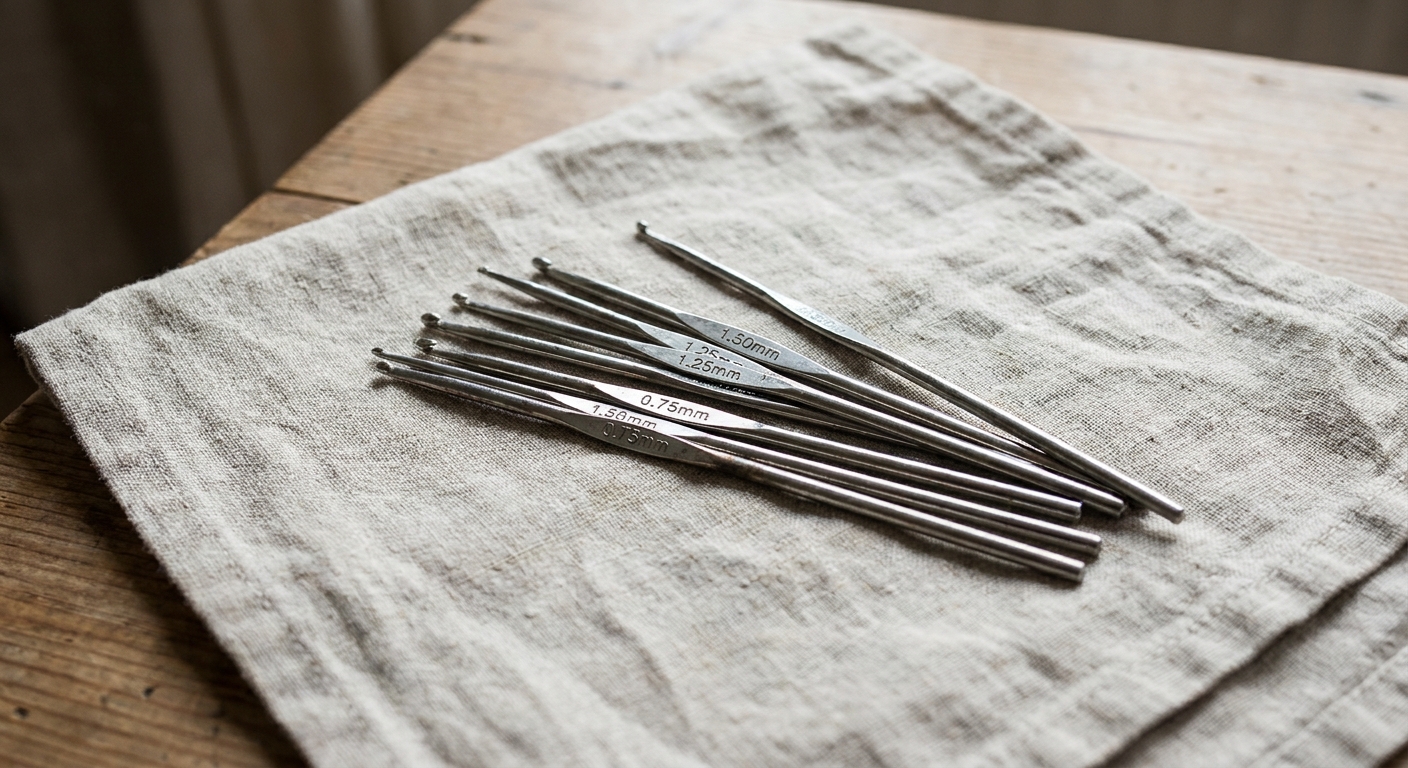
Where sizes are stamped
If you are holding a mystery hook, check these spots first:
- Inline aluminum hooks: the size is often stamped or etched on the flat thumb rest or along the shaft.
- Ergonomic handled hooks: look on the rubber or silicone grip, the plastic handle, or a small printed mark near the metal shaft.
- Wood or bamboo hooks: the size may be laser-etched on the handle, but it can wear down with lots of cozy crocheting.
- Steel hooks: the size is usually stamped on the handle end or a flattened section, and it can be tiny.
If the marking has rubbed off, you have a few options:
- Compare it to a hook you know in millimeters.
- Use a needle gauge tool that includes crochet hook holes.
- If you have calipers, measure the shaft diameter in millimeters.
- Make a small swatch. Your stitches will tell you a lot.
Why the same size feels different
It is not your imagination. Two hooks both labeled H can measure slightly differently, and even true-to-size hooks can still crochet up differently.
Here is why that happens:
- Letter sizes are a naming convention, not a measurement. Millimeters are the measurement.
- Brands map letters to millimeters differently. One brand’s H might be 5.0 mm, another might treat H as closer to 5.25 mm.
- Manufacturing tolerances exist. Even within a brand, a hook can be off by a hair.
- Hook head shape changes the feel. Two hooks can both be 5.0 mm at the shaft, but differences in the throat and head geometry affect the size of the working loop you pull up, which can shift your effective gauge.
- Inline vs tapered matters. Switching styles can change your tension and stitch shape without changing the millimeter number.
- Finish and coatings affect glide. A slicker or grippier surface changes how the yarn slides, which changes your hands, which changes your tension.
That is why patterns that list mm are so helpful, and why I always treat the millimeter number as the anchor when I swap hooks.
What changing hook size does
Think of hook size like the breath in your stitches. A slightly bigger hook invites more air into the fabric. A slightly smaller hook squeezes it out.
Go up one hook size
- Looser fabric with more drape
- Bigger stitches, so your project can measure larger
- More open holes and more visible stitch definition
- Often faster progress, since each stitch takes up more space
Go down one hook size
- Denser fabric with less drape
- Smaller stitches, so your project can measure smaller
- Tighter gaps, often better for amigurumi and anything you do not want to see stuff-show-through
- Can feel stiffer, and it may be harder on hands if your tension is already snug
A one-size change is often a small step, typically about 0.25 mm to 0.5 mm in the most common ranges. In practice, that can still shift gauge enough to matter for sweaters, hats, and fitted items.
Also worth saying out loud: even with the same mm hook, yarn choice and stitch pattern can change gauge dramatically. When fit matters, a swatch is the final authority.
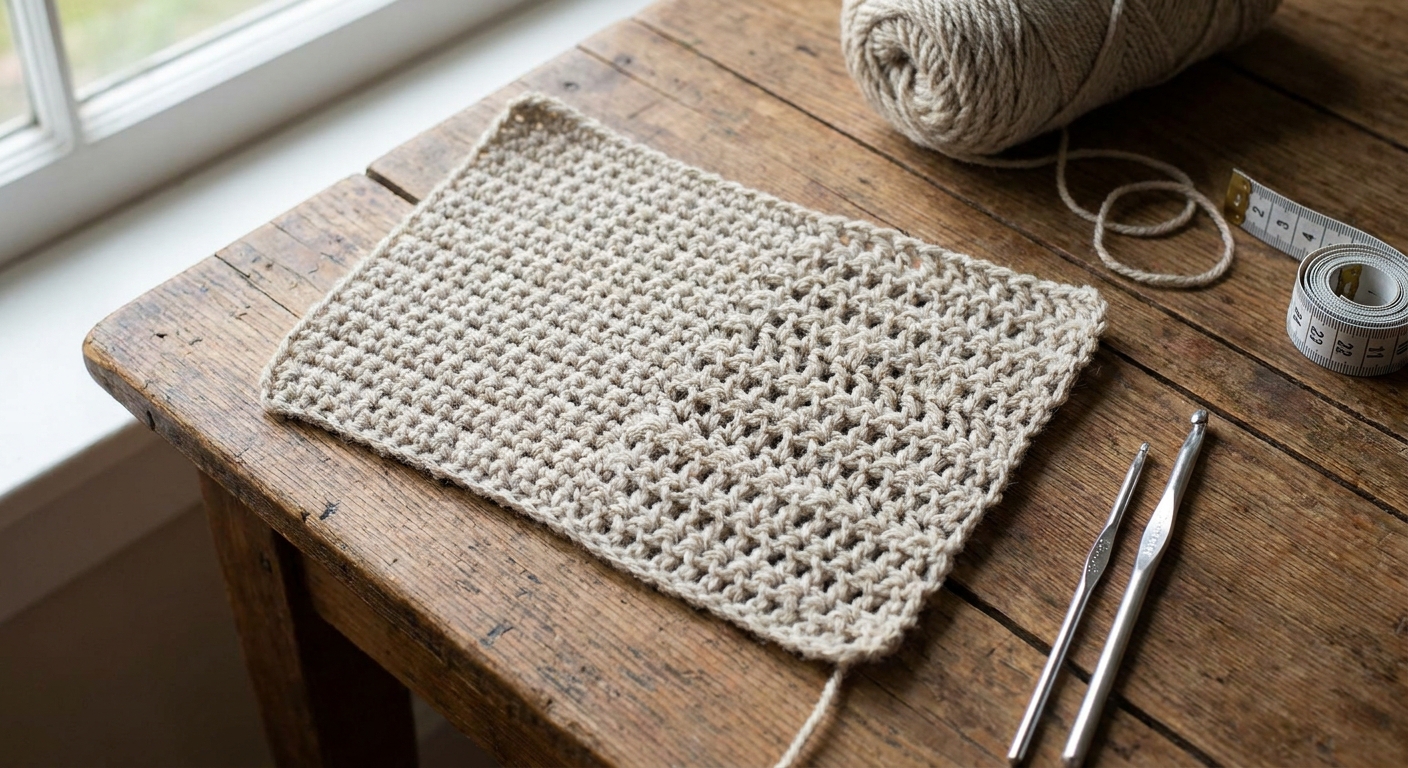
Match pattern hooks to yarn
Yarn labels usually suggest a hook size range in millimeters (sometimes paired with a US letter). Patterns typically give a specific hook size used by the designer.
Here is a calm way to line them up.
Step 1: Translate the pattern hook to mm
- If the pattern says H/8, that is commonly about 5.0 mm.
- If the pattern says I/9, that is commonly about 5.5 mm.
- If it already lists mm, you are ahead by a whole row.
Step 2: Read the yarn label as a range
Even if your label highlights one number, treat it like a range suggestion. For example, a label might recommend 5.0 mm to 5.5 mm for a typical fabric with that yarn.
Step 3: Choose the fabric
- Want drape for a scarf or shawl? You might live at the top end of the label range.
- Want structure for a bag base? You might go toward the lower end.
- Want to match a pattern’s gauge? Start with the pattern hook, then adjust to hit the listed gauge.
A quick example
Say the pattern calls for H/8 and your yarn label suggests 5.0 mm to 5.5 mm. You can:
- Start with 5.0 mm (a typical H/8 equivalent).
- Swatch and measure gauge.
- If you are coming out tight, move up to 5.5 mm and swatch again.
The goal is not to obey the hook. The goal is to get the fabric you want.
Hook size FAQ
Is a 5.0 mm hook always an H/8?
Often, yes. But not always. Many brands label 5.0 mm as H/8, while others may map H to a slightly different millimeter. If the hook is marked 5.0 mm, trust the millimeter.
My pattern lists a letter, but my hook only shows millimeters. What do I do?
Use the chart above to convert the letter to an approximate millimeter, then choose the closest mm hook you have. If gauge matters, swatch and adjust.
Why does my gauge change when I switch hook brands but keep the same size?
Even at the same millimeter, differences in hook head shape, finish, and how the yarn slides can change your tension. Your hands respond to the tool, even when the number stays the same.
Do UK crochet hooks use different letters?
UK sizing historically used numbers, and those numbers are not reliably standardized across older sources. Many modern UK patterns now list millimeters, which is wonderfully straightforward. When you see UK numbers, cross-check mm whenever you can.
What if the pattern gives two hook sizes?
That is common in garments and some textured projects. Usually one hook is for the main fabric and the smaller one is for ribbing, edgings, or areas that need a firmer hand. Follow the pattern, then adjust if gauge asks you to.
Are regional patterns different beyond the UK?
Sometimes. Many Canadian patterns follow US letters, while Australian and New Zealand patterns often stick to millimeters. When in doubt, look for the mm and swatch.
A tidy tip
If you only remember one thing, remember this: millimeters are the universal language. Letters and numbers are friendly nicknames, but mm is what keeps you steady when you swap brands, shop online, or inherit a hook with the label half rubbed away.
Now. One more row. Then just one more.