If you have ever followed a crochet pattern that casually says something like “make a bobble” and you felt your soul briefly leave your body, hi. Welcome. You are not alone. Bobble, puff, and popcorn stitches all create that deliciously bumpy, 3D texture we love on hats, sweaters, blankets, and little critter noses. The tricky part is that they look similar at a glance, but they are constructed differently, they behave differently, and patterns do not always use the terms consistently.
Let’s make it simple: the difference comes down to where the stitches are closed, how many partial stitches you build, and which stitch “base” you are using (half double crochet, double crochet, treble, etc.). Once you understand the structure, you can spot them in the wild and make them confidently, even if your yarn stash is staring at you like it needs a new textured cardigan immediately.
The quick difference
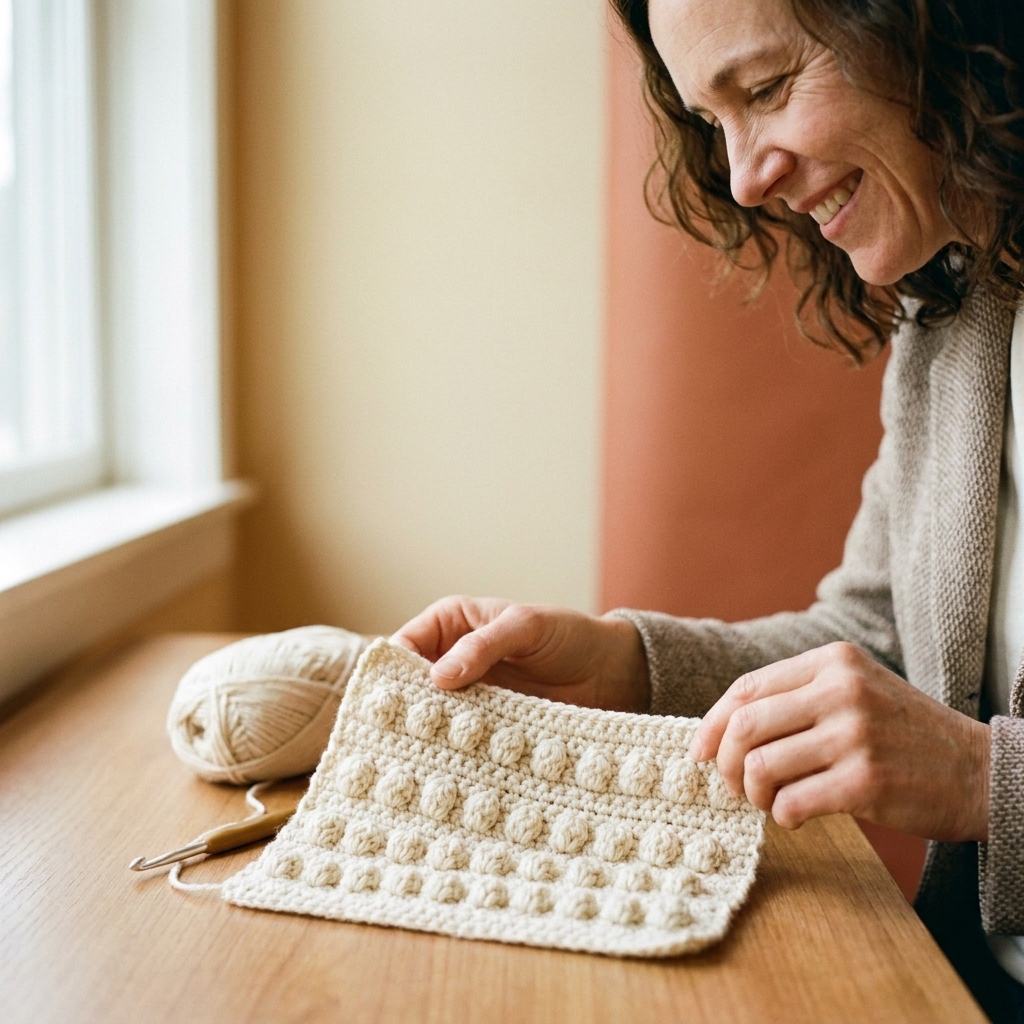
- Puff stitch: You build multiple yarn overs and pull-ups into the same stitch, then close everything together at the end. The result is rounded and soft, like a little cloud.
- Bobble stitch: You work several partial stitches (often partial double crochets) into the same stitch, then close them together into one top. This makes a firm nub that can sit to the back in many recipes unless the pattern is designed to keep it on the right side.
- Popcorn stitch: You crochet several complete stitches into the same stitch, then join the first and last stitch together to “pop” the group into a ball. It is typically the most structured and “ball-like” of the three.
One more important note: designers vary the exact counts. A “5-dc popcorn” is common. A bobble might be 3, 4, 5, or even 6 partial stitches. A puff might be written as “yo, insert, pull up a loop” repeated 3 to 7 times. The method is what defines the stitch.
How they are built
Puff stitch structure
A puff is made by creating a bundle of loops on your hook using repeated yarn overs and pull-ups without finishing the stitch each time. Then you yarn over and pull through all those loops to close.
Key idea: A puff is basically “a bunch of loops gathered into one top.”
Bobble stitch structure
A bobble is made by working several partial stitches into the same stitch. Most commonly, that means partial double crochets: yarn over, insert, pull up a loop, yarn over, pull through two loops, then stop. Do that several times, then close all the remaining loops together.
Key idea: A bobble is “several half-finished stitches gathered into one top.”
Popcorn stitch structure
A popcorn is made by crocheting several fully completed stitches into the same stitch (often double crochet), dropping the loop, inserting the hook into the first stitch of the group, picking the dropped loop back up, and pulling it through. That joining action makes the cluster curl outward into a ball.
Key idea: A popcorn is “several finished stitches that get joined to each other.”
How to crochet a puff stitch
There are many puff variations. This is a very common, beginner-friendly puff worked in a single stitch. If your pattern says something like “puff st” with a loop count, follow the loop count given.
Classic puff stitch
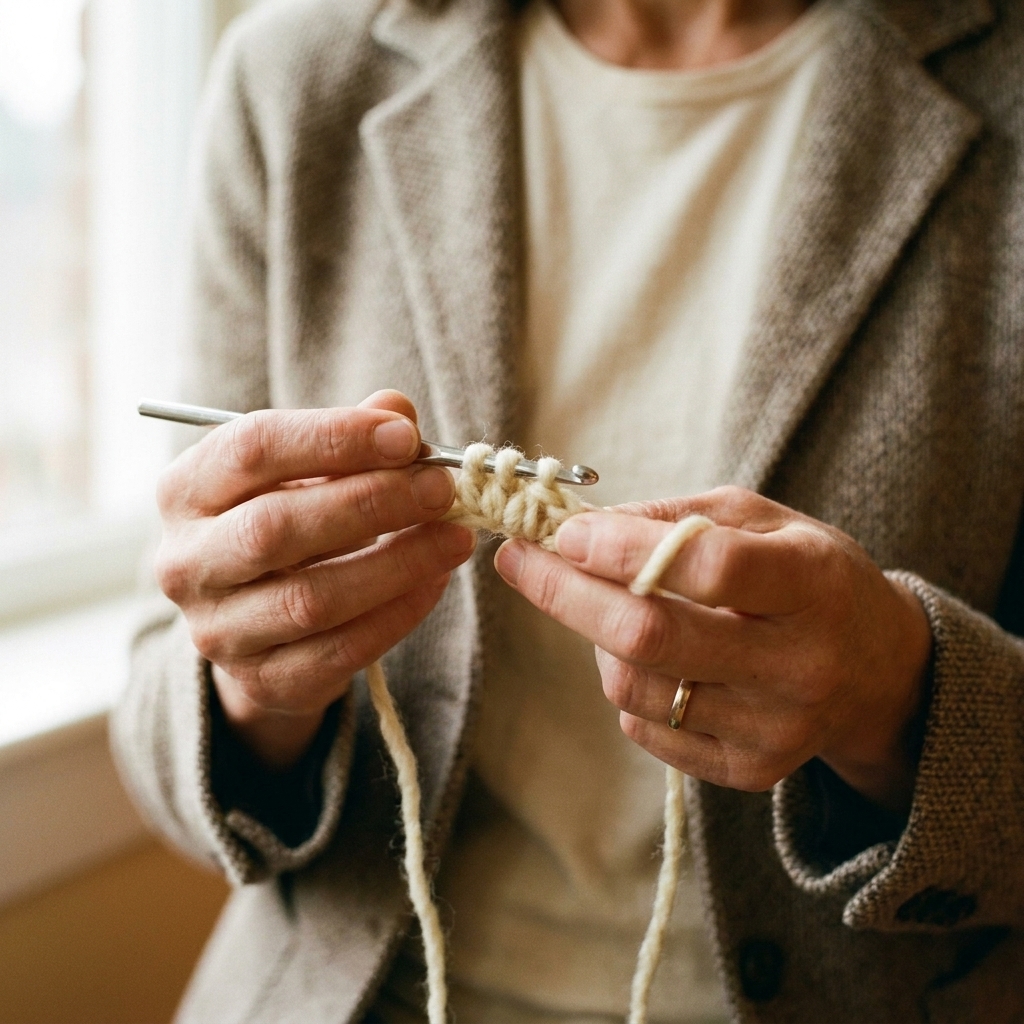
- Step 1: Yarn over.
- Step 2: Insert hook into the indicated stitch.
- Step 3: Yarn over and pull up a loop. (You now have 3 loops on the hook.)
- Step 4: Repeat Steps 1 to 3 two to four more times in the same stitch, depending on the pattern. Each repeat adds two more loops.
- Step 5: Yarn over and pull through all loops on the hook to close the puff.
- Step 6 (often included): Chain 1 to lock the puff in place, if the pattern tells you to.
How it should feel: A puff is plush and squishy. If yours looks skinny, pull your loops up a bit taller before closing.
How to crochet a bobble stitch
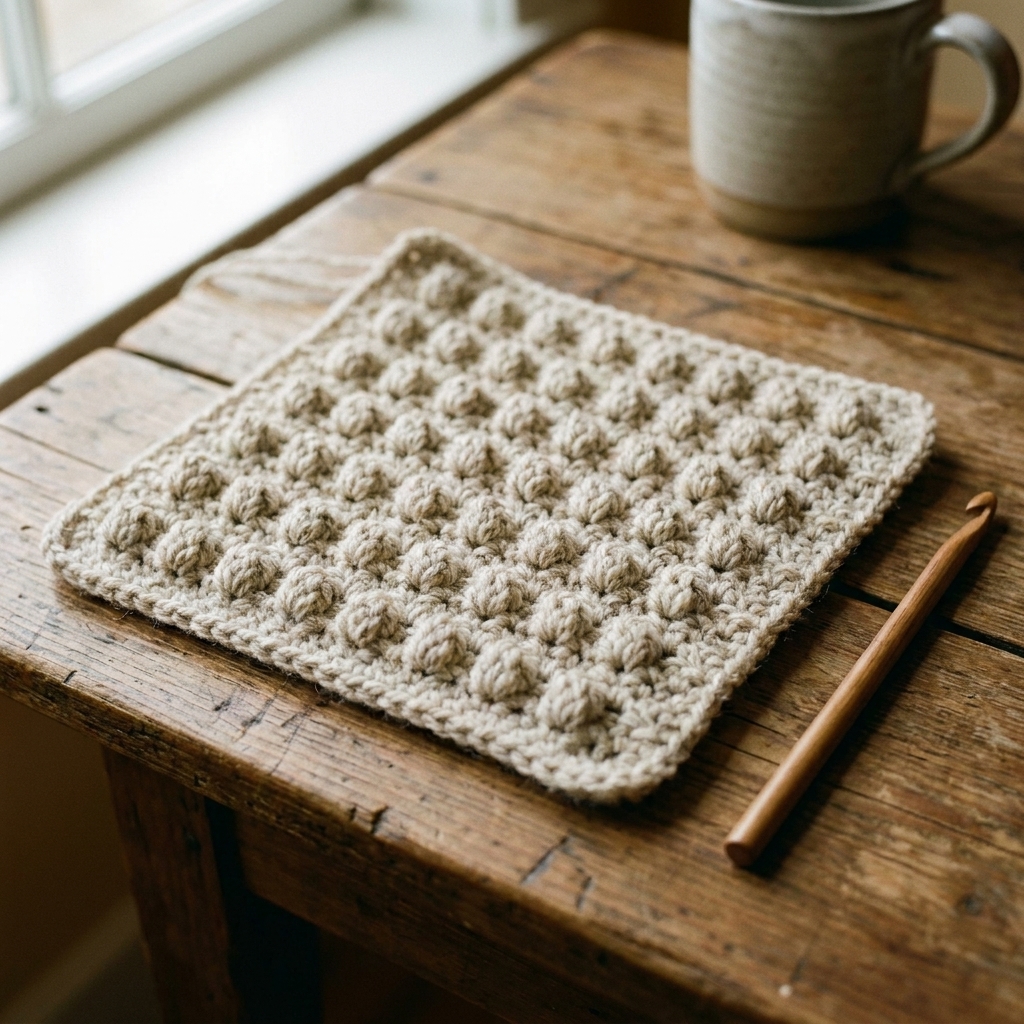
Bobble stitches are most often made using partial double crochets, but you will also see half double crochet bobbles, treble bobbles, and more. The “bobble” name is about the gathering method, not the stitch height.
5-dc bobble
- Step 1: Yarn over, insert hook into the indicated stitch, yarn over and pull up a loop.
- Step 2: Yarn over and pull through 2 loops. Stop. (You have 2 loops left on the hook.)
- Step 3: Repeat Steps 1 and 2 four more times in the same stitch. Each time you stop with 2 loops on the hook. By the end, you will have multiple loops stacked up.
- Step 4: Yarn over and pull through all loops on the hook to close the bobble.
Right side versus wrong side: Depending on the recipe and surrounding stitches, bobbles often want to sit on the wrong side of the fabric, and some patterns are written with that in mind. Other patterns are designed so the bobble naturally stays on the right side without any fuss. If your bobbles look like they are hiding, give them a gentle nudge forward with your finger after you close them, and check your pattern notes for the intended side.
How to crochet a popcorn stitch
A popcorn stitch is usually labeled by how many stitches it contains, like “pc (5 dc)” or “5-dc popcorn.” You can make popcorns with half double crochet or treble too, but double crochet is the classic.
5-dc popcorn
- Step 1: Work 5 double crochets into the same stitch.
- Step 2: Remove your hook from the active loop (do not pull it out, just drop it gently).
- Step 3: Insert hook into the top of the first double crochet of the group (many patterns have you go front to back, but follow your pattern if it specifies a direction).
- Step 4: Put the active loop back on your hook.
- Step 5: Pull the active loop through the first stitch to join. The cluster will “pop” outward.
Pro tip for neat popcorns: After Step 5, many patterns have you chain 1 to secure the popcorn. Follow the pattern. That tiny chain can be the difference between a crisp popcorn and a floppy one.
How to spot them
If you are looking at your work (or a pattern photo) and trying to identify what you are seeing, here are the giveaways.
Puff stitch looks like
- A soft oval or round “pillow”
- Often a visible chain-1 “cap” on top if the puff is locked
- More airy and plush than a bobble or popcorn
Bobble stitch looks like
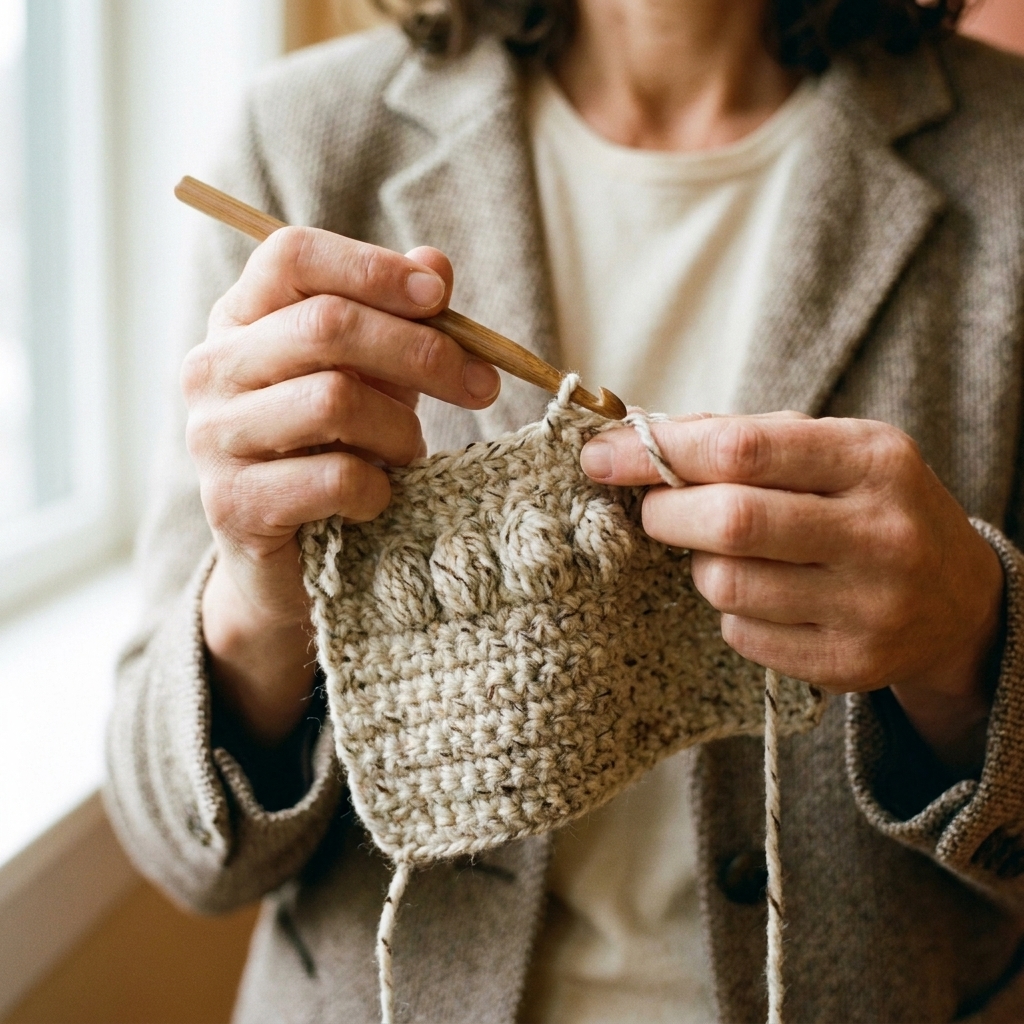
- A firm nub with a slightly flatter top
- Often sits between taller stitches and can look more compact
- May sit to the back in some patterns, especially if the pattern is worked and turned
Popcorn stitch looks like
- The most “ball-like” and defined bump
- Often you can see the individual stitch posts wrapped around each other
- Holds its shape well and stands out strongly
Right side and turning
This is the part that trips up a lot of beginners: which side you are on matters.
- If you are working in rows and turning every row, a texture stitch might naturally “present” on the opposite side when you turn. Many patterns plan for this and will say things like “bobble on RS only” or will have you work bobbles on a wrong-side row so they pop on the right side.
- If you are working in the round (or working flat without turning), the bumps tend to be more predictable because you keep facing the same side.
- If your pattern includes a note like “push bobble to RS,” trust it. If it does not mention pushing at all, it may be written so the stitch sits correctly on its own.
Which one to use
All three add texture, but they behave differently in drape, stretch, and weight. Here is how I choose, especially for wearables.
Choose a puff stitch when
- You want a soft, squishy texture that still drapes nicely
- You are making baby items, scarves, or cozy blankets
- You want texture without adding a ton of stiffness
Choose a bobble stitch when
- You want a bold texture that reads clearly from a distance
- You are making hats, yokes, cuffs, or geometric patterns
- You want a sturdy bump without the “ball” look of a popcorn
Choose a popcorn stitch when
- You want maximum definition and structure
- You are adding accents like hearts, dots, or raised motifs
- You do not mind a little extra thickness and yarn usage
Slow fashion note: Textured stitches use more yarn. That is not a bad thing. It just means your project will be warmer, heavier, and often longer-lasting. If you are making a garment, swatch first so you love the fabric before you commit.
Yarn and tension tips
Pick yarn that shows texture
- Best: smooth, plied yarns in solid or lightly heathered colors
- Trickier: fuzzy mohair, heavy halo yarns, highly variegated colorways (your beautiful bumps can disappear)
Mind your loop height
For puffs especially, the height of your pulled-up loops controls the shape. If you pull them too short, your puff looks tight and cramped. Too tall and it can look loose. Aim for consistent loop height every time.
Expect these stitches to eat yarn
Puffs, bobbles, and popcorns are yarn-hungry. If you are playing yarn chicken, these stitches will win. Every time.
Give your fabric room to breathe
If your background stitches are too tight, the bumps can feel crowded. Consider going up a hook size for the background fabric if your pattern allows, or consciously relax your tension between texture stitches.
Common hiccups
“My puff stitch has a hole under it.”
This usually means your puff is tall but not snugged down. After you pull through all loops, gently tighten the closing loop and work the securing chain (if included) with normal tension, not extra loose.
“My bobbles keep disappearing to the back.”
Totally common in some patterns. If your pattern expects bobbles on the right side, it may tell you to push them forward, or it may use a stitch recipe that naturally keeps them on the front. After closing the bobble, use your finger to pop it to the right side if needed. Also check that you are placing the next stitch correctly so it does not squish the bobble backward.
“My popcorn is flat and sad.”
Popcorns need that join between the first and last stitch to curl. Make sure you insert into the top of the first stitch (not the space), and pull the loop through firmly enough to create the pop. A securing chain after joining often helps, if your pattern calls for it.
“My stitch count is off after texture stitches.”
Each puff, bobble, or popcorn normally counts as one stitch at the top, even though it is made from many partial or complete stitches. The most common exception is when a pattern tells you to count (or not count) the securing chain-1 as part of the stitch. When in doubt, follow the pattern’s stitch count rule and place a marker in the top of the texture stitch until your eyes learn what it looks like. Future you will be grateful.
Pattern abbreviations
Because designers write these stitches in slightly different ways, always check the pattern notes. That said, here are common ways you will see them written:
- Puff: “puff st,” “puff,” “ps,” or a written instruction like “(yo, insert, yo, pull up loop) x4, yo, pull through all, ch 1.”
- Bobble: “bobble,” “bo,” “dc bobble,” “5dc bobble,” or “(yo, insert, pull up, yo, pull through 2) x5, yo, pull through all.”
- Popcorn: “popcorn,” “pc,” “5dc pc,” “pop st,” often followed by the joining instruction.
If a pattern uses “cluster” instead of these names, read carefully. In crochet, “cluster” sometimes means a bobble-like closure, sometimes a decrease, and sometimes its own thing entirely. My rule is: trust the written steps more than the label.
FAQ
Are bobble, puff, and popcorn stitches the same thing?
Not technically. They are all 3D texture stitches, but a puff gathers loops, a bobble gathers partial stitches, and a popcorn joins completed stitches to force a pop.
Which one uses the most yarn?
Popcorns often use the most because you fully complete several stitches, then join them. Bobbles and puffs also use extra yarn, just usually a bit less than a similarly sized popcorn.
Which is easiest for beginners?
Puffs are often the most beginner-friendly because you stay in one spot and simply close a bundle of loops. Bobbles are a close second. Popcorns are still beginner-appropriate, but the “drop the loop and reinsert” step can feel fiddly the first few times.
Can I substitute one for another?
Sometimes, yes, with a little swatching. Substituting changes thickness, stitch height, and sometimes stitch count or spacing. If you are working a garment, swatch the substitution and check your fabric drape and gauge before committing.
A quick pep talk
These stitches are supposed to feel a bit awkward at first. You are basically convincing yarn to make tiny fabric bubbles, and yarn has opinions. Give yourself permission to practice on a small swatch, make one slightly lopsided popcorn, laugh at it, and then make the next one better. That is not “messing up.” That is learning.
If you want a low-pressure way to practice, make a simple square swatch and work one row of puffs, one row of bobbles, and one row of popcorns. Label nothing. Just let your hands learn what each one feels like. Your future textured cardigan will thank you.